Digital TDS Meter
Digital TDS Meter
$27.45
Regular price
Check your water's dissolved solids in seconds, and see when your RO membrane is due.
Read moreCouldn't load pickup availability
One number for your water. In seconds.
Dip it in a glass and read it. A TDS meter is the quickest way to see your filter or RO system at work.
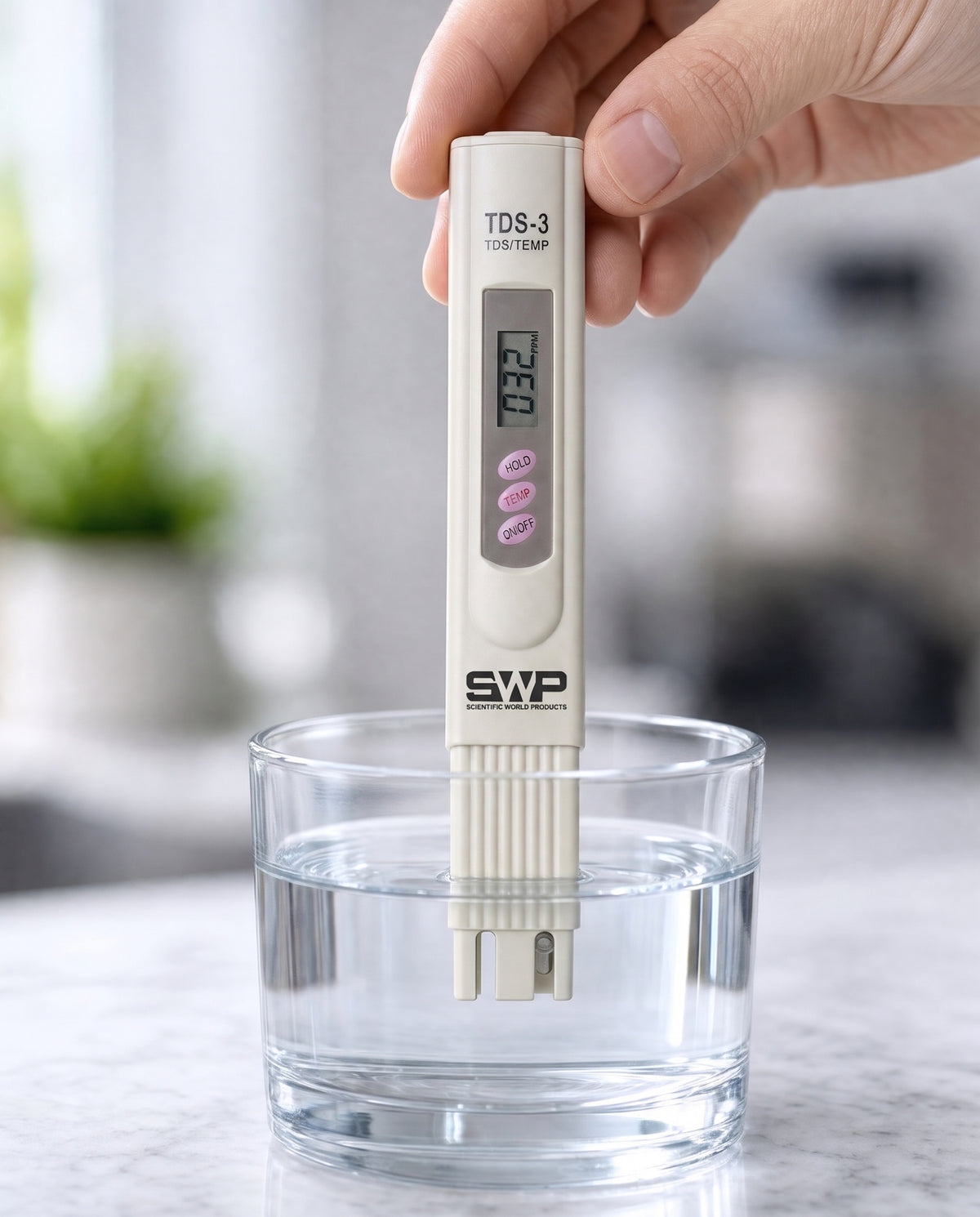
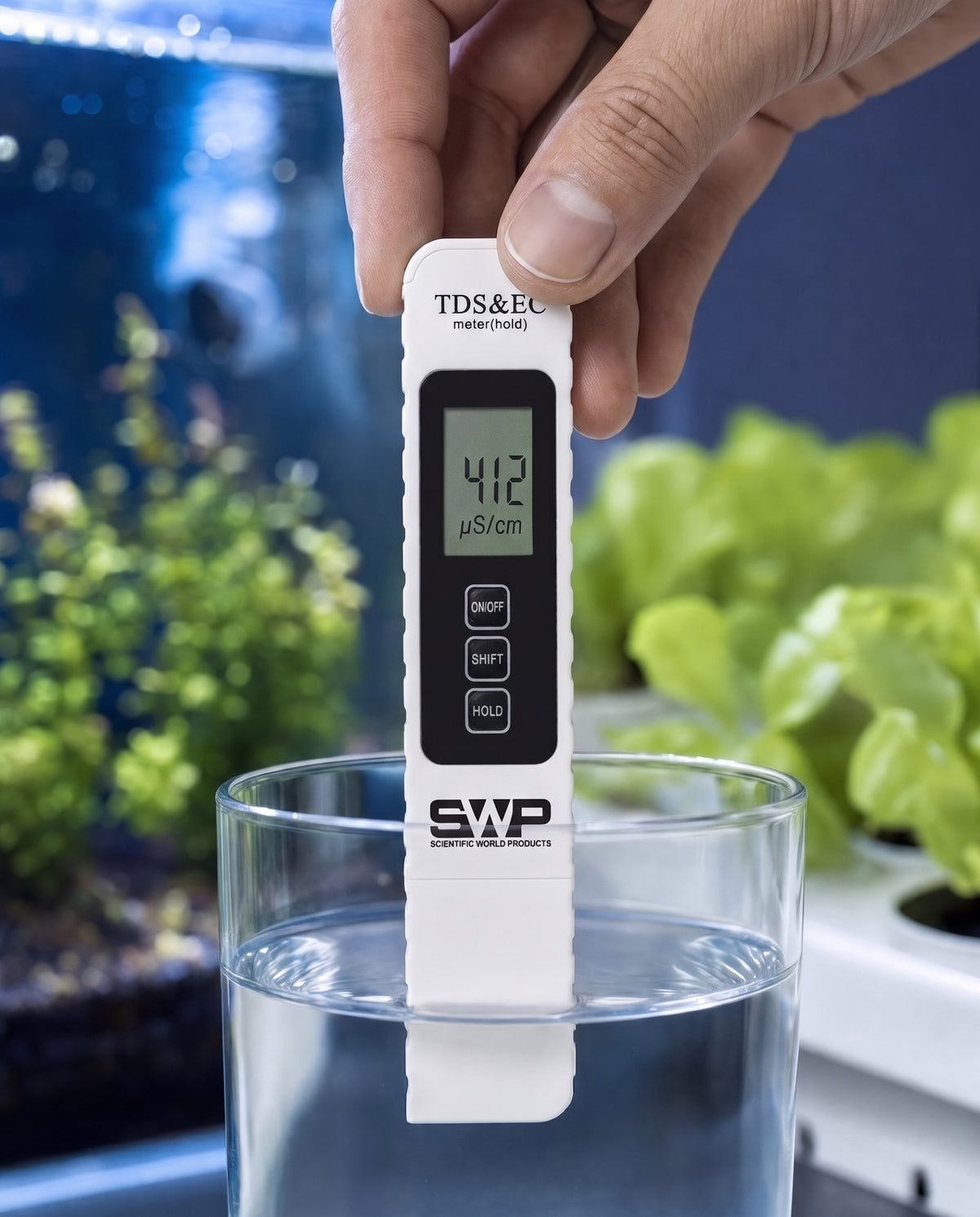
How a TDS meter reads water
Two metal probes pass a tiny current through the water. Dissolved minerals and salts carry that current, and the meter turns it into parts per million.
Conductivity
The more that is dissolved, the more easily water carries current.
Parts per million
The display shows an estimate of total dissolved solids in ppm.
Temperature
Both models also show the water temperature.
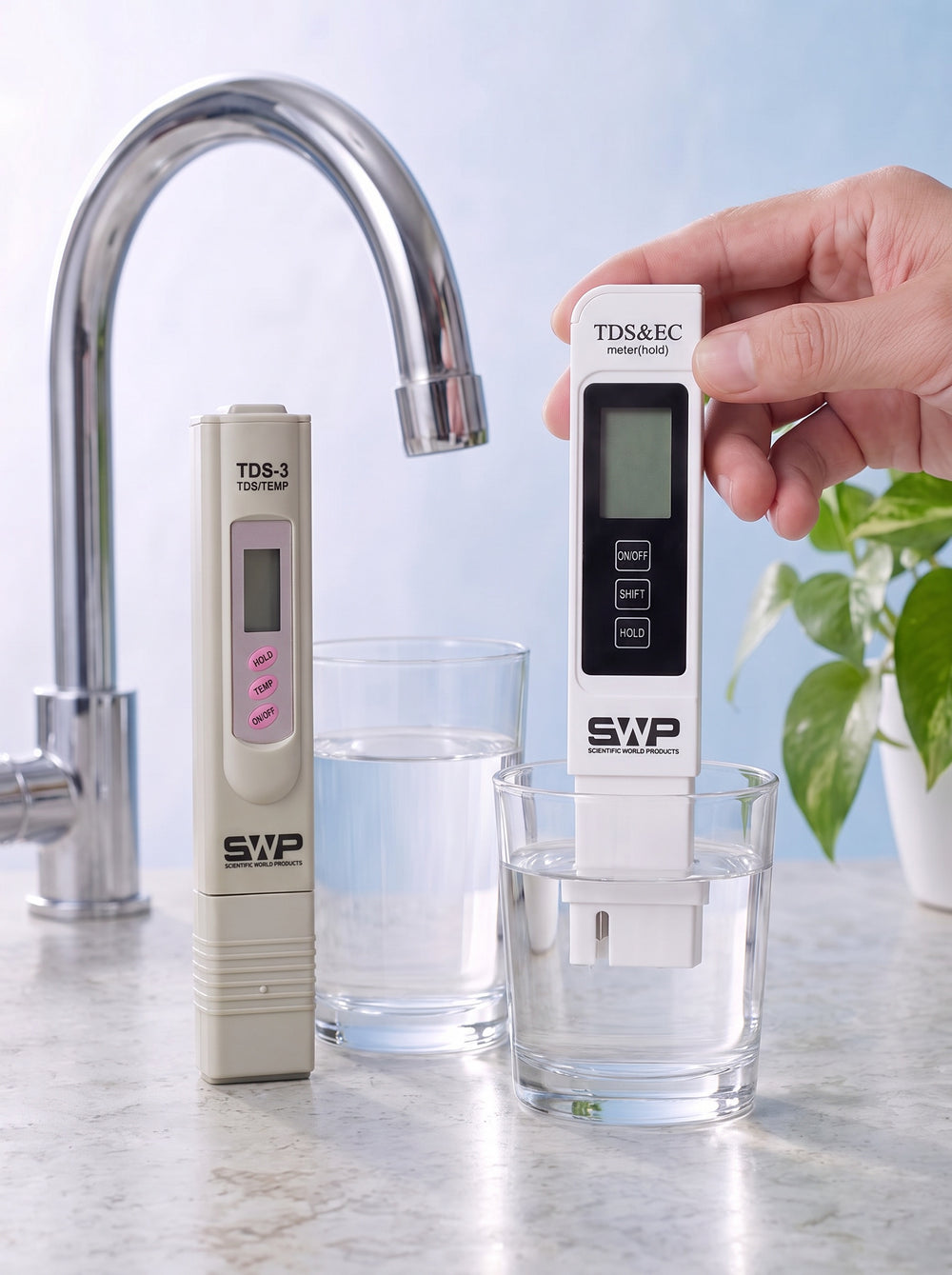
Pick your meter
Same quick reading, two ways to use it.
TDS-3
TDS and temperature on three simple buttons. Made for checking tap, filtered and RO water at home.
TDS & EC
Adds conductivity in µS/cm, the unit growers and aquarium keepers use. Reads up to 9,999 ppm, ±5%, with automatic temperature compensation.
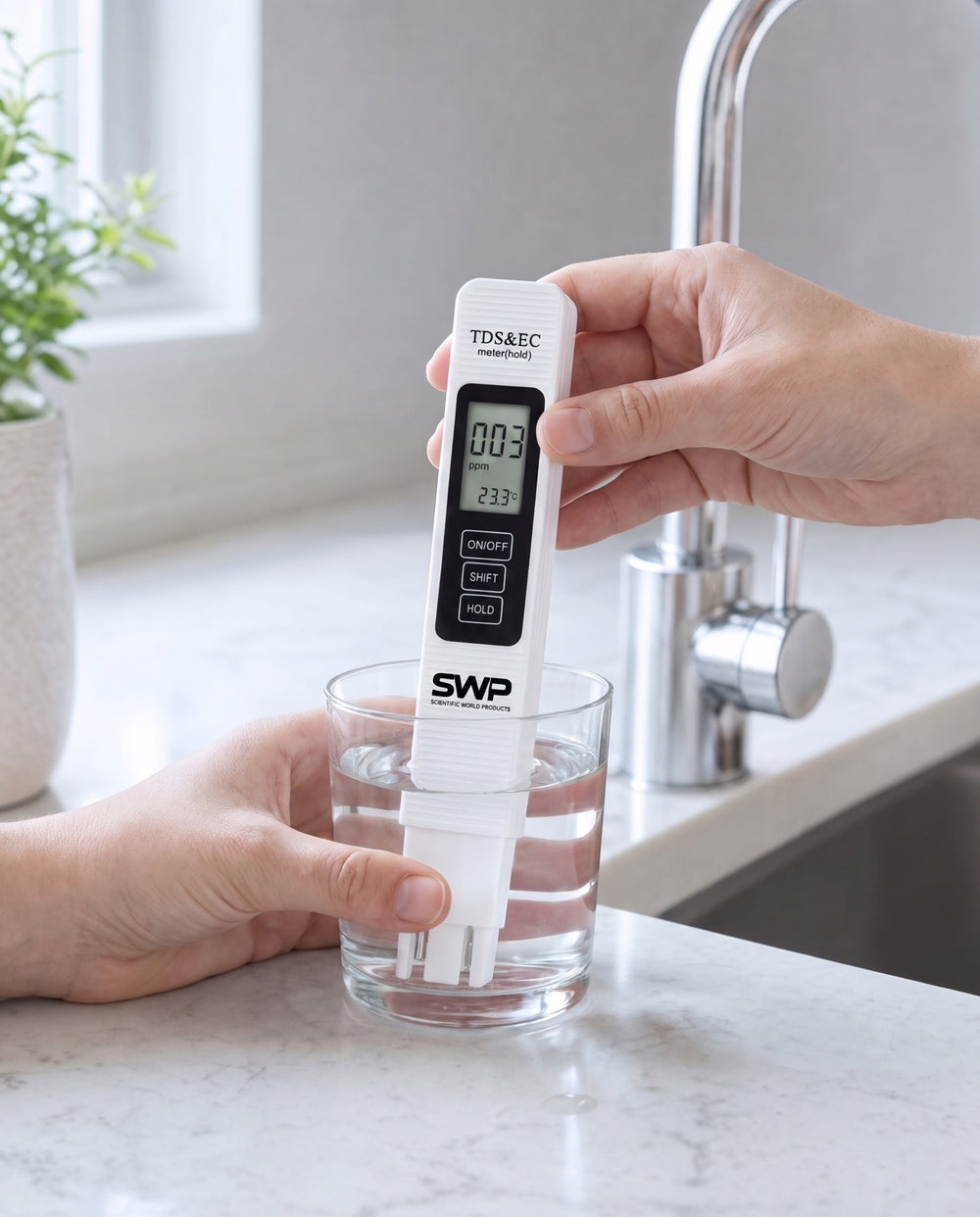
Is your RO still working? Find out in a minute
Two readings and a comparison. Repeat every month or two and you will see a tired membrane coming.
Tap
Read a cup of cold tap water.
RO faucet
Read a cup from your RO faucet. It should be far lower.
Track it
When the RO number starts to climb, check your pre-filters and membrane.

A starting point, not a safety test.
TDS counts everything dissolved, healthy minerals included. It cannot see lead, PFAS, bacteria or nitrate. For those, a certified lab test is the answer.
Why Crystal Quest
Buy your meter from people who read TDS every day, and help with what your numbers mean comes with it.
Over 30 years of manufacturing
We have designed and built water filtration systems since 1994.
Water filtration experts
We test water every day, so we can tell you what your reading means and what to do about it.
Commercial quality
The same ISO 9001 quality system behind our commercial and industrial systems.
Questions about fit or returns? A filtration specialist answers by phone, email or chat. Read the refund policy
Description
Is my reverse osmosis system still working? Is my filter doing anything? What is actually in my tap water? A TDS meter gives you a first answer in about ten seconds. Dip it in a glass and it shows total dissolved solids (TDS): the minerals, salts and metals dissolved in your water, in parts per million (ppm).
We use TDS meters constantly to check that an RO membrane is still doing its job. This is the same quick check, in your pocket.
At a glance
- Reads TDS in ppm in seconds, with no strips or reagents
- Shows water temperature on both models
- HOLD button freezes the reading so you can lift the meter out and read it
- Protective cap keeps the probes clean between tests
- Two models: the TDS-3, or the TDS & EC that adds electrical conductivity in µS/cm
Which model is right for you?
- TDS-3 (TDS + Temp): the simple one. Three buttons (HOLD, TEMP, ON/OFF) for TDS and water temperature. Right for checking tap, filtered and RO water at home.
- TDS & EC (TDS, EC + Temp): adds an EC reading in microsiemens per centimeter (µS/cm) and switches between readings with the SHIFT button. Reads TDS from 0 to 9,999 ppm and EC from 0 to 9,999 µS/cm, accurate to ±5%, with automatic temperature compensation, a titanium alloy electrode and auto shut-off after 5 minutes. A good pick for hydroponics and aquariums, where EC is the usual unit.
How to check your RO system
- Run cold water from your kitchen tap for a few seconds and read a cupful.
- Read a cupful from your RO faucet.
- Compare. Reverse osmosis removes most dissolved solids, so the RO reading should be far lower than the tap reading.
- Write the numbers down and repeat every month or two. When the RO reading starts to climb, it is time to look at your membrane and pre-filters.
What a TDS reading cannot tell you
A TDS meter measures how easily water carries a small electrical current, then converts that to an estimate in ppm. It counts everything dissolved together, healthy minerals like calcium and magnesium included, and it does not say what any of it is. A low number is not a safety verdict: a TDS meter cannot detect lead, PFAS, bacteria, nitrate or pesticides. For those, a certified water test is the answer. Learn more in our guide, How to Use a TDS Meter (and What It Can't Tell You).
Questions? We are here
Not sure what your reading means for your water or your system? Our water specialists have helped customers since 1994. Reach us by phone, email or chat.
Specifications
- Product
- Handheld digital TDS meter, pen style
- Models
- TDS-3 (TDS + temperature); TDS & EC (TDS, EC + temperature)
- TDS & EC: readings
- TDS in ppm, conductivity (EC) in µS/cm, water temperature in °C or °F
- TDS & EC: TDS range
- 0 to 9,999 ppm
- TDS & EC: conductivity range
- 0 to 9,999 µS/cm
- TDS & EC: temperature range
- 0.1 to 80.0 °C (32 to 176 °F)
- TDS & EC: accuracy
- ±5%
- TDS & EC: temperature compensation
- Automatic
- TDS & EC: electrode
- Titanium alloy
- TDS & EC: buttons
- ON/OFF, SHIFT, HOLD
- TDS & EC: auto shut-off
- After 5 minutes with no button pressed
- TDS & EC: memory
- Turns on in the mode you last used
- TDS & EC: size
- 154 x 30 x 14 mm (about 6.1 x 1.2 x 0.6 in)
- TDS & EC: weight
- 45 g (about 1.6 oz), meter only
- TDS & EC: power
- 3V button cell battery
- TDS & EC: marking
- CE
- TDS & EC: max immersion
- 3 cm from the tip (the immersion line); not waterproof
- TDS-3: readings
- TDS in ppm, water temperature
- TDS-3: buttons
- HOLD, TEMP, ON/OFF
- TDS-3: TDS range
- 0 to 9,999 ppm
- TDS-3: resolution
- 1 ppm up to 999 ppm; 10 ppm from 1,000 to 9,999 ppm (shown by the x10 symbol)
- TDS-3: accuracy
- ±2%
- TDS-3: calibration
- Factory calibrated
- TDS-3: temperature range
- 0.1 to 80.0 °C (32 to 176 °F)
- TDS-3: temperature compensation
- Automatic
- TDS-3: size
- 155 x 31 x 23 mm (about 6.1 x 1.2 x 0.9 in)
- TDS-3: weight
- 43 g gross, as printed on the box
- TDS-3: power
- Two 1.5V button cell batteries
- Display
- Digital LCD
- Measures
- Total dissolved solids (estimated from conductivity), water temperature; EC on the TDS & EC model
- Does not measure
- Specific contaminants (lead, PFAS, bacteria, nitrate, pesticides), hardness on its own, pH, chlorine
How to use & care
Parts & Components
Parts included
- One Digital TDS Meter, the model you choose
- Protective electrode cap (on the meter)
- Batteries included